
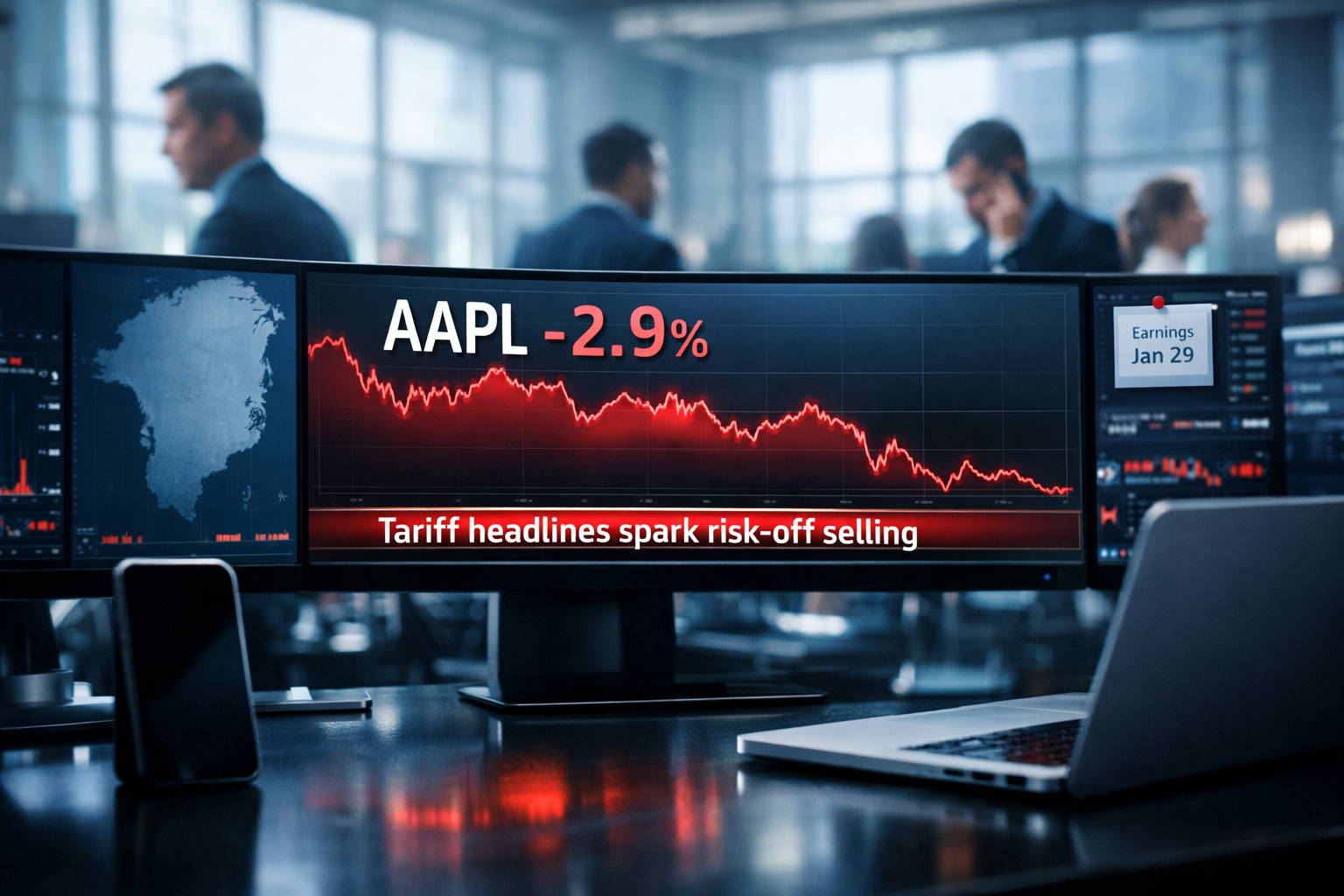
Apple stock (NASDAQ: AAPL) slid nearly 3% on Tuesday, even as Evercore and Citi issued constructive notes ahead of the company’s earnings report due January 29.
The disconnect highlights a fundamental market tension as analyst optimism over the iPhone 17 cycle collided with broad risk-off positioning driven by Trump’s escalating Greenland tariff threats.
Tariff headlines outweighed the upgrade
The broader market context tells the story.
On Tuesday, major tech stocks retreated as investors fled to safety following Trump’s renewed tariff threats on European nations, 10% tariffs beginning February 1, escalating to 25% by June unless Denmark cedes Greenland.
The Nasdaq 100 and the so-called “Magnificent Seven” mega-cap tech names all declined in tandem, signaling a sector-wide rotation rather than Apple-specific weakness.
Apple stock’s 3% decline mirrors this market structure.
When tariff rhetoric dominates headlines, investors don’t distinguish between Apple’s strong iPhone demand and macro headwinds.
Instead, they see exposure to manufacturing disruption in Asia and supply chain uncertainty that could force Apple to either absorb higher costs or pass them to consumers.
Apple stock: Analyst optimism collides with near-term cost concerns
Evercore ISI added Apple to its “Tactical Outperform” list on January 20, citing expectations for near-term upside to Street estimates ahead of earnings.
The firm raised its iPhone revenue forecast to $17% year-over-year growth versus consensus $11%, driven by premiummodel mix and higher average selling prices.
Citi similarly framed Apple as a buy, with a $330 price target and optimism on the iPhone 17 cycle and Apple’s shift to advanced chip packaging in 2026.
Yet here’s the complication: Citi simultaneously lowered its price target from $330 to $315 and reduced estimates to reflect rising memory component costs.
Specifically, DRAM (the memory chips inside iPhones and Macs) contract prices are projected to surge 40-70% in the first quarter of 2026 as Apple’s long-term supply agreements expire.
Memory typically represents 10-15% of an iPhone’s total manufacturing cost.
If Apple can’t secure favorable terms with suppliers like Samsung and SK Hynix, margins could compress significantly beginning in the second and third quarters of 2026.
Evercore claims Apple is “well shielded” through December and March quarters due to existing agreements, but that protection expires.
Apple’s earnings report on January 29 will be the critical catalyst.
Management must convince investors that memory cost inflation won’t materially compress margins through 2026, and that tariff risks remain distant threats rather than immediate headwinds.
If guidance disappoints on either front, Tuesday’s 3% decline could look like a footnote to a larger selloff.
The Apple stock remains a hold for long-term investors, but near-term volatility looks set to persist until the margin outlook clarifies.
The post Apple stock tumbles nearly 3% despite analyst upgrade: here’s why appeared first on Invezz
